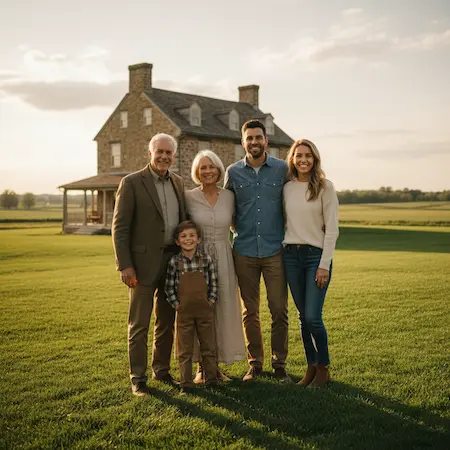
Land in Loudoun County isn’t just property. It’s personal.
Maybe it’s a farm outside Purcellville that’s been in your family for decades. Maybe it’s a few wooded acres near Waterford where your kids grew up exploring. Maybe it’s land you’ve held onto because you couldn’t imagine letting it go—and you’re starting to wonder what happens to it when you’re gone.
Here’s the truth most families don’t want to sit with: without a clear plan, land doesn’t just pass down. It becomes a problem. And the more it’s worth, the bigger that problem tends to be.
Loudoun County land values have climbed dramatically over the past two decades. What your parents bought for a reasonable sum may now be worth millions. That’s great news on paper. But it also means the conversations your family never had—about who gets what, who decides, who can sell—start to matter a whole lot more.
Why Land Causes More Conflict Than Anything Else
Money is easy to divide. Land isn’t.
You can split a bank account four ways without anyone arguing about it. You can’t always do that with forty acres of farmland. Subdividing rural property isn’t as simple as drawing lines on a map. Zoning rules, road access, well placement, and soil conditions all affect whether a piece of land can even be divided—and what it’s worth if it is.
But the harder problem isn’t legal. It’s emotional.
Land carries history in a way that money doesn’t. One sibling farmed it. Another grew up playing in the fields. A third moved away years ago and sees it as a financial asset they’ve never really connected with. Put those three people in a room and ask them what should happen to it, and you’ll understand why so many families end up in disputes that take years—and a lot of money—to resolve.
What Virginia Law Does If You Don’t Have a Plan
If a Loudoun County landowner dies without a will, Virginia decides what happens next.
Under Virginia Code § 64.2-400, the property goes to the heirs according to the state’s default rules—typically split equally among children or surviving relatives. Equal sounds fair. But equal ownership of a single piece of land is complicated in practice. Now everyone owns a share of something nobody can individually control.
And here’s the part that surprises most families: any one of those co-owners can go to court and force a sale. It’s called a partition action, and any co-owner has the right to file one. That means a single heir—even one acting purely out of frustration or financial need—can force the rest of the family to sell land they desperately want to keep. Once that process is in motion, the family loses control of the outcome.
This isn’t a rare edge case. It happens to ordinary families across Loudoun County every year.
A Will Is a Start—But Be Specific
The simplest thing any landowner can do is write a will that actually addresses the land.
Not just “I leave everything to my children equally.” That kind of language, while common, is what creates the disputes described above. A useful will for a landowner goes further. It names who gets the property. It explains what they can and can’t do with it. It might give one heir the right to buy out the others before any outside sale can happen. It can set conditions, timelines, and instructions that reflect what the landowner actually wanted.
Specific language is one of the most practical gifts you can leave your family. Vague language is one of the most common sources of conflict.
How a Trust Can Keep Land Intact
A trust is one of the most effective tools for passing down rural property—especially when multiple heirs are involved.
The basic idea is straightforward. Instead of leaving the land directly to your heirs, you place it inside a legal structure—the trust—and set the rules for how it gets managed and eventually transferred. Those rules have legal force. They don’t depend on family members agreeing. They don’t require anyone to go to court to enforce them.
A trust can spell out who manages the property, who can use it and when, whether it can ever be sold and under what circumstances, and what happens if one heir wants out. It puts those decisions in writing while the owner is still alive and thinking clearly—not after a crisis, when emotions run high and everyone has a different memory of what mom or dad would have wanted.
Under Virginia’s Trust Code (Virginia Code § 64.2-700 et seq.), a properly set-up trust also bypasses the Virginia probate process entirely. That means the land transfers to the next generation without going through court—faster, more privately, and with far less opportunity for conflict to take hold.
Family LLCs: Separating Ownership From Control
Some landowners with larger or more complex holdings take a different approach: they form a family LLC to hold the property.
This lets family members share in the financial value of the land without giving every person equal say over what happens to it. The LLC’s operating agreement—essentially its rulebook—can spell out exactly who makes decisions, how disputes get resolved, and under what conditions the property can be sold. It separates the question of who owns a piece from the question of who’s in charge.
It’s not a simple solution. LLCs require proper setup and ongoing maintenance. But for families with significant acreage and multiple heirs with competing interests, it can provide a level of structure that a will or trust alone can’t always offer.
Conservation Easements: Protecting the Land Itself
Some Loudoun County families aren’t just thinking about who gets the land. They’re thinking about what happens to the land itself.
A conservation easement is a legal agreement where a landowner voluntarily limits certain uses of the property—development, subdivision, commercial activity—in exchange for tax benefits and the knowledge that the land will be protected in perpetuity. Organizations like the Piedmont Environmental Council and the Virginia Outdoors Foundation work with Loudoun County landowners regularly on exactly this kind of arrangement.
Easements can also reduce the taxable value of an estate, which sometimes makes it financially easier to pass land to heirs who couldn’t otherwise afford the estate tax burden. And because they permanently restrict development, they can take the pressure off future family members who might otherwise feel forced to sell when land values climb.
The tradeoff is real: easements are permanent. They bind future owners, not just the current generation. That’s worth understanding fully before committing.
Virginia also offers property tax relief for qualifying agricultural and forestal land under Virginia Code § 58.1-3230 et seq.—another reason landowners with working farms or timber land should understand how their property is currently classified.
The Conversation Matters as Much as the Documents
Here’s something that gets overlooked in almost every discussion about estate planning: the paperwork is only part of it.
Families that handle land transitions well almost always have one thing in common. The person who owned the land talked about it before they were gone. Not a formal meeting with lawyers in the room—just an honest conversation where they explained what they wanted and why.
When heirs understand the reasoning behind a plan, they’re far less likely to resent it. When they’re left guessing, they tend to fill in the gaps with their own assumptions—and that’s where disputes are born.
A clear legal plan and an honest family conversation aren’t alternatives. They work together. The documents make the wishes enforceable. The conversation makes them understood.
Loudoun County’s open land is one of the things that makes this place feel like home. For families who’ve held onto a piece of it, passing it down well—intact, peacefully, to people who understand what it meant—is one of the most meaningful things that planning can accomplish.
It doesn’t happen automatically. But with the right structure in place, it absolutely can.

Start Planning Today!
(703) 202-0394


